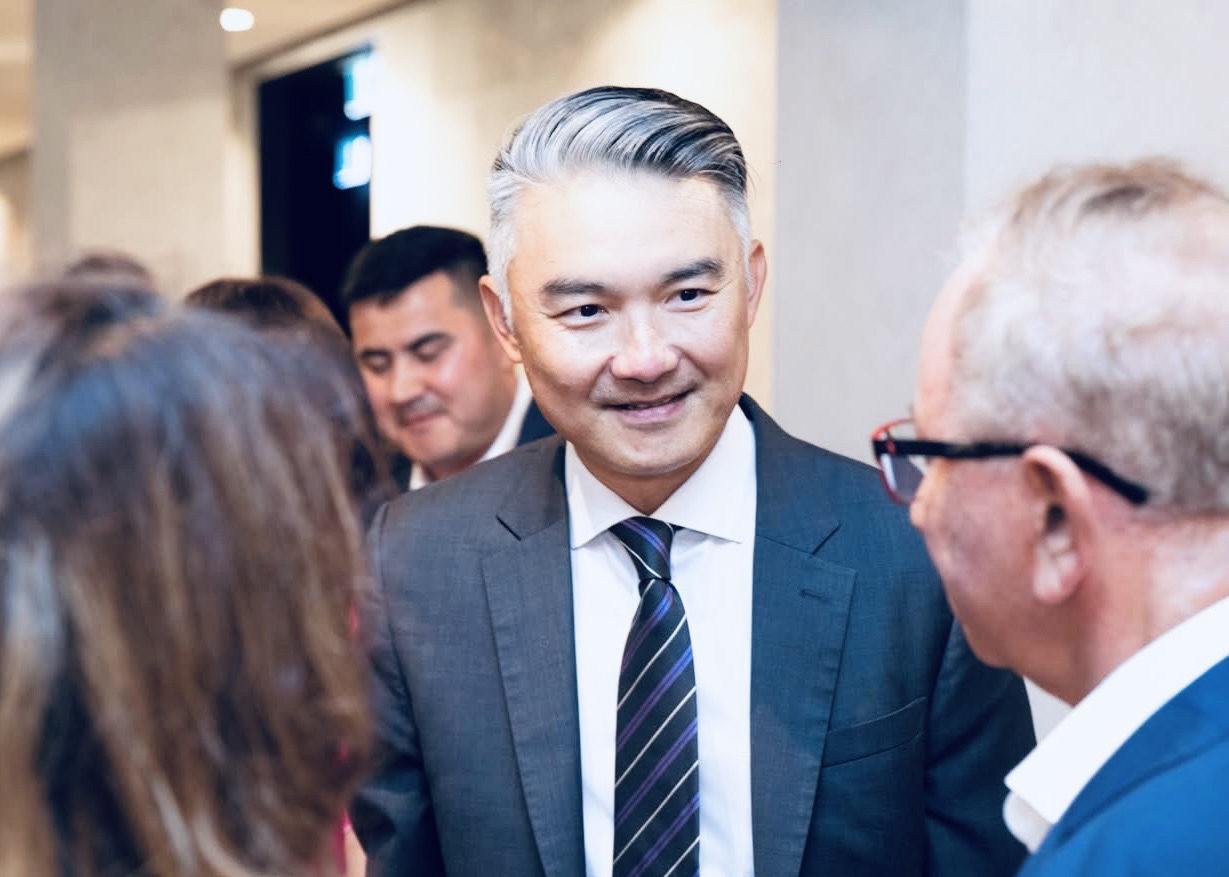
Ray Ming-Tse Lu, Director-General of the Taipei Economic and Cultural Office in Melbourne, recently published an op-ed in the Australian Institute of International Affairs (AIIA) outlet titled “Beyond a Single Voice: Opening the Door for Taiwan in the Indo-Pacific.” In his article, Lu stressed the importance of a correct understanding of UN General Assembly Resolution 2758 and urged Australia to support Taiwan’s meaningful participation in international organizations in order to safeguard regional stability and prosperity.
The op-ed highlighted the February 2025 incident when an Australian P-8A Poseidon conducting a routine flight over the South China Sea was dangerously intercepted by a Chinese J-16 fighter, underscoring growing risks in the Indo-Pacific. The Taiwan Strait, one of the world’s busiest sea lanes, saw between 44 and 50 percent of global container traffic in 2022, with 88 percent of the world’s largest vessels transiting this route. Chinese live-fire drills and ad hoc exclusion zones have repeatedly disrupted shipping and aviation, creating ripple effects for regional trade. Australia’s 2023 Defence Strategic Review has already warned that “grey-zone coercion” poses one of the fastest-growing threats to Australia’s maritime security.
Lu pointed out that Resolution 2758 merely addressed which government holds China’s UN seat. It neither mentions Taiwan nor authorizes Beijing to represent Taiwan. Misinterpretations of this resolution have excluded Taiwan from key technical bodies such as the International Civil Aviation Organization (ICAO) and the International Maritime Organization (IMO), leaving coordination gaps that affect not only Taiwan’s 23 million people but also all countries, including Australia, that depend on these systems.
The article further noted that Taiwan has demonstrated its constructive role internationally. During the COVID-19 pandemic, Taiwan’s transparent reporting and donations of medical supplies supported global responses. In 2013, Taiwan attended the ICAO Assembly as a guest of the Council President, contributing without controversy.
Lu also underlined the strong practical links between Taiwan and Australia. Both are outward-looking, trade-driven economies reliant on open sea lanes and stable air corridors. Taiwan is Australia’s seventh-largest export market, a vital partner for LNG, beef, and education services, and a critical node in the global semiconductor supply chain underpinning Australia’s digital economy. Supporting Taiwan’s meaningful participation in international organizations is therefore not a political gesture but a matter of Australia’s own strategic foresight and national interest.
“Ensuring Taiwan has a seat at the table strengthens the very system that safeguards prosperity and security, and it directly concerns Australia’s future,” Lu emphasized.