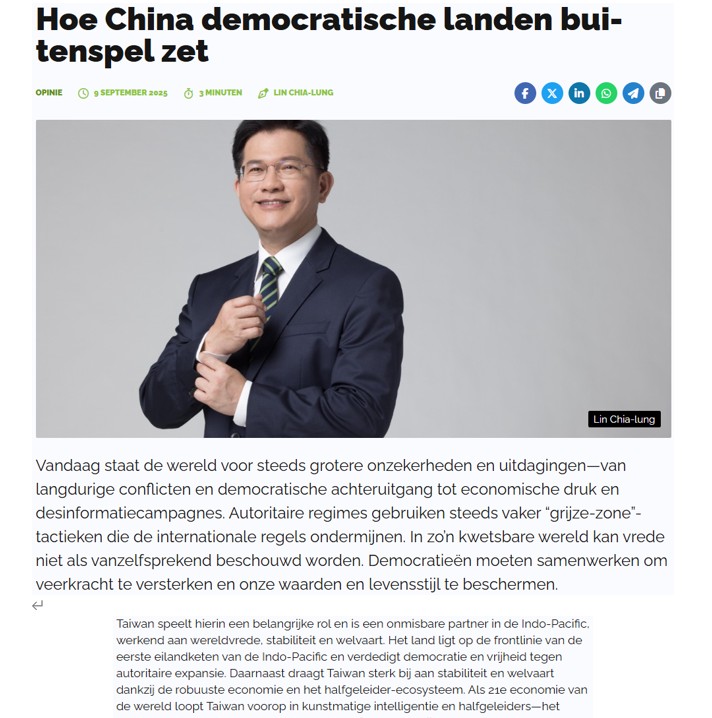
As the UN General Assembly opened on September 9, Dutch media outlet NieuwRechts published in full an op-ed by Foreign Minister Lin Chia-lung, calling on the international community to reject China’s malicious distortion of UNGA Resolution 2758 and to recognize Taiwan’s rightful place and contributions on the global stage.
*Full text of the op-ed:
Today, the world faces increasing uncertainties and challenges—from protracted conflicts and democratic decline to economic pressure and disinformation campaigns. Authoritarian regimes are increasingly using “gray-zone” tactics that undermine international rules. In such a vulnerable world, peace cannot be taken for granted. Democracies must work together to strengthen resilience and protect our values and way of life.
Taiwan plays a key role in this and is an indispensable partner in the Indo-Pacific, working towards world peace, stability, and prosperity. The country is on the frontline of the Indo-Pacific's first island chain and defends democracy and freedom against authoritarian expansion. Furthermore, Taiwan contributes significantly to stability and prosperity thanks to its robust economy and semiconductor ecosystem. As the world's 21st -largest economy, Taiwan is a leader in artificial intelligence and semiconductors—manufacturing more than 60 percent of the world's chips and 90 percent of the most advanced. This economic strength fuels global growth and makes Taiwan an indispensable partner for international development in various areas.
Taiwan is firmly committed to upholding democratic values, both at home and abroad. Last year, President Lai Ching-te launched the “Four Pillars of Peace” action plan, which will increase Taiwan's defense spending and strengthen society's resilience. Taiwan neither seeks nor provokes conflict with China. In fact, Taiwan is urging Beijing to resume dialogue on the basis of equality and respect.
In addition, the Ministry of Foreign Affairs has implemented an “Integrated Diplomacy” approach, through which Taiwan combines its diplomatic, defense, technological, and economic strengths. This smart strategy allows Taiwan to navigate complex international relationships, expand its global presence, and contribute to a more stable and prosperous world.
Through a global network of democratic values, Taiwan is strengthening cooperation with countries facing geopolitical uncertainty to counter authoritarian influence, promote human rights, improve digital governance, and respect international rules. Taiwan is demonstrating that democracy can endure and flourish, even under pressure.
As an economic powerhouse, Taiwan is a leader in the production of semiconductors and advanced technologies. Its economic strength is driving innovation and growth in AI, digitalization, and healthcare. To strengthen this position, Taiwan has developed an economic diplomacy strategy focused on reliable, transparent supply chains outside China's sphere of influence, thus protecting critical industries from authoritarian interference.
Taiwan is also actively involved in the “Diplomatic Allies Prosperity Project,” in which the government and businesses collaborate to leverage Taiwan's industrial strengths for mutually beneficial development. Examples include: collaborating with Paraguay to develop an integrated hospital information system; collaborating with Eswatini on an oil reserve project to boost energy security and local industry; and assisting Palau to become a smart and sustainable island nation, as an example of Taiwan's commitment to sustainable international cooperation.
Unfortunately, despite all these contributions, Taiwan remains largely ignored by the international community and is excluded from the United Nations. This exclusion is unjustified and is the result of China's misinterpretation and misuse of UN General Assembly Resolution 2758 to exclude Taiwan.
Resolution 2758 does not mention Taiwan—it only addresses China's representation in the UN. The resolution does not declare Taiwan part of the People's Republic of China, nor does it grant China the right to represent Taiwan at the UN. Yet, the UN has yielded to political pressure from China, and the resolution is being used as a pretext to exclude Taiwan.
Taiwan is speaking out against this and is receiving increasing international support. A growing number of countries are emphasizing the importance of peace and stability in the Taiwan Strait, both bilaterally and in multinational forums such as the G7. Governments and parliaments have publicly stated that Resolution 2758 neither defines Taiwan's status nor blocks its participation in international organizations, including the UN and the International Civil Aviation Organization (ICAO).
As the United Nations celebrates its 80th anniversary—and with only five years left until the Sustainable Development Goals (SDGs)—it is time to fulfill the promise of “leaving no one behind” and becoming “better together” by including Taiwan.
Taiwan invites the world to participate and contribute by giving Taiwan its rightful place on the global stage and recognizing the contributions it can make. Only by working together can we create a better and brighter future for the Indo-Pacific and the world.