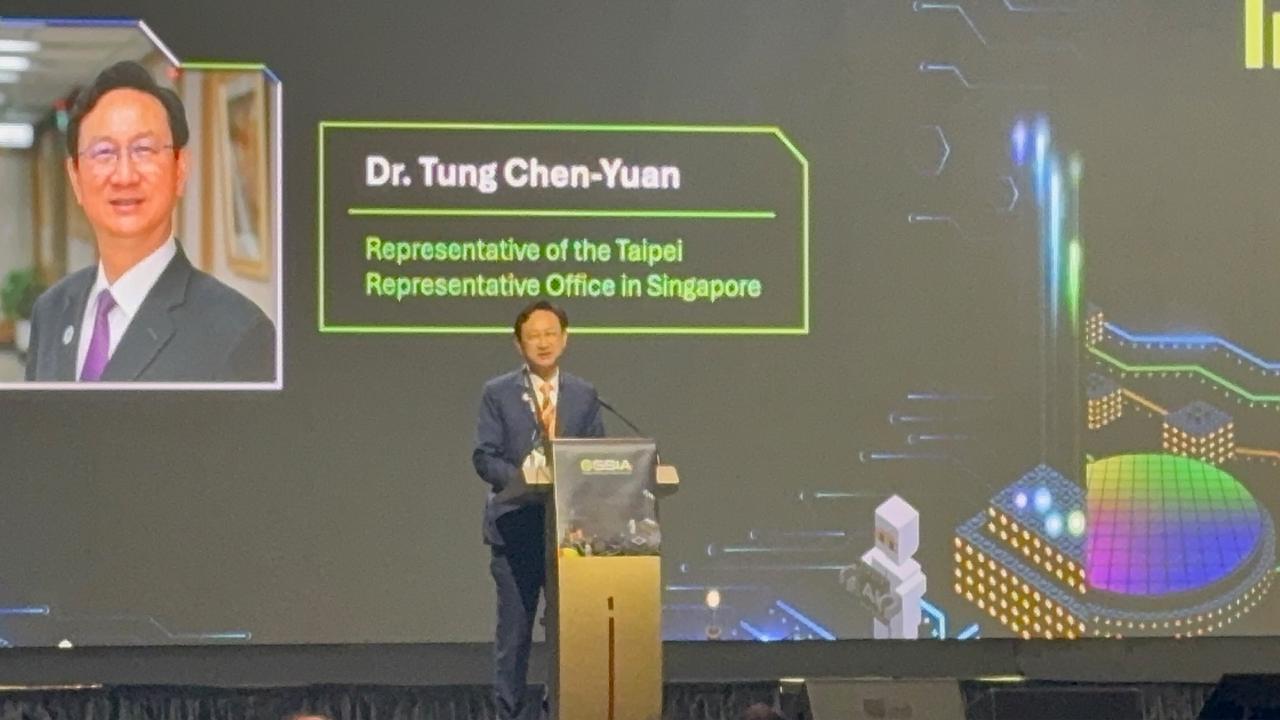
SSIA Summit Opens in Grand Style; Ambassador Tung Chen-Yuan Highlights Taiwan as the World’s Most Trusted Semiconductor Hub
The Singapore Semiconductor Industry Association (SSIA) held SSIA Summit 2026 today (September 24) at Resorts World Sentosa. Under the theme “Innovate and Scale Beyond Boundaries: From Leadership to Ecosystem Impact,” this year’s summit attracted more than 900 international participants from industry, government, academia, research institutions, and the media—the largest attendance in the event’s history.
In recognition of Taiwan’s pivotal role in the global semiconductor supply chain, the organizers invited Ambassador Tung Chen-Yuan, Taiwan’s Representative to Singapore, to deliver a keynote address. Speaking on “Beyond Boundaries: Forging Trusted Ecosystems, Multiplying Impact for Semiconductor Growth,” Ambassador Tung shared Taiwan’s experience as a global semiconductor powerhouse, examined developments in the world’s major semiconductor economies, and outlined concrete avenues for closer cooperation with international partners.
Ambassador Tung described this year as an extraordinary one for the semiconductor industry. Earlier in the summit, SSIA Executive Director Ang Wee Seng and ZenSemi CEO KC Ang had called on the industry to “connect, share, and innovate beyond boundaries.” Echoing that message, Ambassador Tung emphasized that the semiconductor industry must pursue both growth and resilience, with success depending on stakeholders working together to build interconnected industrial ecosystems grounded in mutual trust.
AI Drives Explosive Growth in the Global Semiconductor Market
Ambassador Tung noted that, at the beginning of the year, most institutions had projected the global semiconductor market to reach approximately US$1 trillion. The latest forecasts now put that figure at around US$1.65 trillion, with further growth of approximately 30% expected next year, taking the market beyond US$2.1 trillion—a pace of expansion rarely seen in decades.
AI is the principal driver of this growth. Capital expenditure by the world’s nine largest cloud service providers is projected to total approximately US$886.7 billion this year, an increase of around 90% over last year, with a further rise of approximately 50% expected next year. This investment is creating substantial opportunities across the semiconductor supply chain.
Taiwan Has the World’s Most Comprehensive Semiconductor Ecosystem
Ambassador Tung explained that Taiwan plays a leading global role across IC design, wafer fabrication, and semiconductor packaging and testing. In 2025, Taiwan accounted for approximately 78.6% of the global foundry market and 48.1% of the packaging and testing market. The value of Taiwan’s semiconductor industry output is projected to grow by approximately 40% this year. TSMC’s share of the global foundry market reached 72.5% in the second quarter of this year, with a gross margin of 67.7%. Its capital expenditure for the full year is expected to reach US$60 billion to US$64 billion.
Ambassador Tung emphasized that, as a central hub for global chip manufacturing, packaging, and testing, Taiwan is advancing a global expansion strategy with Taiwan at its core. This strategy supports Taiwanese companies in entering international markets while actively encouraging leading global supply chain partners to increase their investment in Taiwan.
Addressing concerns about manufacturing capacity moving overseas, Ambassador Tung clarified that TSMC has consistently adhered to the principle of building “three fabs in Taiwan for every fab overseas.” Thirteen fabs are currently under construction in Taiwan, with the cumulative total expected to reach 25 over the next five years. According to an assessment by Taiwan’s Ministry of Economic Affairs, as much as 85% of TSMC’s production capacity will remain in Taiwan by 2030. Its most advanced process technologies and core R&D resources will also remain firmly rooted in Taiwan, underscoring Taiwan’s resilience as an indispensable center of the global semiconductor industry.
Ambassador Tung also highlighted the importance of Singapore’s semiconductor industry, noting that it accounts for approximately one-third of the country’s manufacturing output. Singapore is a major Asian hub for multinational corporations and a critical node in global chip manufacturing and supply chains. Taiwan became Singapore’s largest trading partner last year, and bilateral trade has grown by 94.1% this year, reflecting increasingly close ties across the AI and semiconductor supply chains.
As global supply chains undergo restructuring, Ambassador Tung said, no single market can manage every stage on its own, and Taiwan is the most trusted choice for international partners. He proposed three avenues for cooperation. First, companies can integrate into Taiwan’s key industrial clusters, drawing on its scale and extensive partner networks to multiply the benefits of collaboration. Second, they can establish equipment and materials supply bases in Taiwan, which has been the world’s largest semiconductor materials market for 15 consecutive years. Third, they can establish R&D and operations centers in Taiwan to advance technological innovation together.
Deepening Taiwan–Singapore Exchanges in Semiconductors and AI
Taiwan and Singapore are highly complementary across the semiconductor supply chain. Taiwan will continue to build on its strengths in advanced chip manufacturing and R&D, combining them with Singapore’s expertise in precision manufacturing, financial services, and regional logistics. Together with regional partners, the two sides will work to build a resilient, secure, and innovative global semiconductor ecosystem while bringing more international investment and collaboration opportunities to Taiwan’s industries.
To help stakeholders across Singapore better understand the importance of Taiwan’s semiconductor industry, the Taipei Representative Office in Singapore has published the [Taiwan and Global Semiconductor Report] every two months since September 2023. Since September 2025, the office has also partnered with the Global Taiwan Technology and Diplomacy Alliance to publish the [Taiwan and Global AI Report] every two months, providing the latest developments and analysis of Taiwan’s industries. Through these publications, the office hopes to deepen the Taiwan–Singapore partnership and encourage more Singaporean companies to invest in Taiwan.
Ambassador Tung has also actively engaged with stakeholders across Singapore. To date, he has delivered more than ten talks at think tanks, banks, industry associations, and semiconductor company gatherings, presenting Taiwan’s strengths in semiconductors and AI and highlighting opportunities for bilateral cooperation. He said he would continue these speaking engagements and exchanges to further expand Taiwan–Singapore collaboration in both fields.