


By JIM HWANG
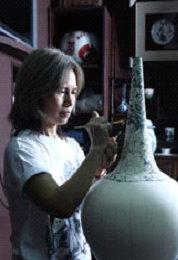
The elegant simplicity of blue and white porcelain has attracted Yang Li-ly for more than three decades. (Photo by Huang Chung-hsin)
Yang Li-ly has devoted the past three decades to creating blue and white porcelain and boosting the popularity of the art.
Chinese brush painting has always been appreciated for its color—or rather, its lack of color—as the focus is on shades of black and the space surrounding the subjects that is “left white” on purpose as part of the composition. By using the same tools and skills, but replacing black ink and paper with cobalt oxide pigment and clay, artisans create Chinese blue and white porcelain, which has also long captivated and inspired the world. “The beauty lies in the elegant blue and the simplicity,” says Yang Li-ly, who has been working on the art of blue and white porcelain for more than three decades.
The technique of applying cobalt blue on white porcelain ware, which originated in the Middle East, reached its fullest development in China, with its superior porcelain technology, in the 14th century. “Antique Chinese blue and white porcelain has been treasured by collectors and museums all over the world,” Yang says. “What’s interesting, however, is that blue and white ware seems to have been mainly crafted as merchandise rather than art objects in Taiwan.” During the 1960s and 1970s, tens of thousands of workers on factory production lines in Taiwan mass produced reproductions of antique vases and plates to fill foreign orders, as well as for tourists visiting Taiwan. China Pottery Arts Co. was the largest such manufacturer. According to the National Repository of Cultural Heritage, the company was founded in 1958 in the Beitou District of northern Taipei City. When the market for such reproduction porcelain items was at its peak, China Pottery Arts had more than 1,000 employees crafting all styles of products.
Yang became one of them after joining the company in 1978 at the age of 19, marking her first job and also her first encounter with porcelain. The young girl had just graduated from high school and had little art training other than art classes and some experience in producing posters at school. “I was interested in art but had no idea about porcelain,” Yang says. “I needed a job for family reasons, and I applied for work at China Pottery Arts because it was the nearest business to my home.”
Crafting mass produced porcelain, Yang discovered, did not require much skill or experience. So after some basic training, she became one of the many workers on the production line. Repeating the same coloring and painting the same patterns, vase after vase, was boring and almost killed off Yang’s interest in art, until she was transferred to the blue and white porcelain department. “For some reason, I was deeply attracted by the elegance of the different shades of blue and the methods of presenting them,” she says.
Since the technique of painting blue and white porcelain is similar to that of Chinese brush painting, Yang began studying under Yu Zhong-lin (1925−1985), who was a master of the detailed drawing style of Chinese painting. Yang recalls that the monthly tuition for learning from Yu was NT$1,600 (US$40 at the exchange rate then) and her monthly pay was only NT$3,000 (US$75). She could not afford to take a lot of classes, so she had to pick up as much as she could in a few months, as well as through a lot of practice.
Learning from a master was very helpful for Yang’s painting skills, but not for her job. As one of the workers on the production line, Yang was still drawing the same designs laid out by master artists or copied from porcelain ware in museum collections. “I wanted to use my own designs,” Yang says. “But I figured it’d never happen if I stayed at that job.” After two years on the production line, Yang therefore quit her job at China Pottery Arts and went on to work for some smaller companies. Her main consideration, she explains, was to gain better opportunities to use her own designs at these smaller companies.
Shades of Blue
Meanwhile, Yang also started to experiment with cobalt pigment. She explains that while there is no secret to the basic formula, cobalt oxide pigments from different suppliers and variations in concentration can result in different shades of blue. After many experiments, Yang worked out her ideal formula of pigment and water, one that has become known to the local ceramic community as “Yang Li-ly cobalt blue.” It is difficult to describe in words how her particular blue differs from others, but there is a unique quality about it that makes it stand out. According to Yang, her pigment is also easier to use with Chinese brush pens.
Not long after leaving China Pottery Arts, however, Yang realized she did not have much of a shot in the trade, as the blue and white porcelain business, along with porcelain manufacturing in Taiwan as a whole, had been declining since the early 1980s. Foreign buyers turned to countries in Southeast Asia and mainland China for cheaper products, and the number of tourists visiting Taiwan also dropped sharply due to changes in international politics. Since the domestic market had shown little interest in blue and white porcelain, losing foreign buyers and tourists basically meant losing the entire market. Faced with this situation, many companies closed down, some moved overseas and others shifted from recreating antique ware to developing their own products.
Yang was not about to give up on blue and white porcelain, but she knew that she needed to make some changes. To make ends meet, she began devoting part of her time to Chinese painting, creating popular works such as “door gods” or traditional paintings celebrating the Lunar New Year. “It would’ve been great if I could’ve made a living by creating blue and white porcelain,” she says. “But in reality, I needed a ‘job’ to support myself and my passion for it.” Her “relationship” with porcelain companies also changed. Instead of working for them, as she had done before, Yang began to work with them in creating new pieces. Today, she buys unglazed molds from one company, paints her designs on them and sends them to another company for firing. “I can paint, but I know nothing about the clay, molding and firing, so I have to rely on other professionals,” she explains. “I put the name of the craftsman who makes the mold and the name of the company that kilns the piece beside mine because it’s a team effort.”
For years, Yang took the early train from Taipei City to Yingge Township, Taipei County and worked for 10 to 12 hours before taking the late train home. This pattern continued until 1998, when her marriage ended and she took on the role of a single mother. After getting divorced, she decided to move to Yingge and made another effort at becoming a professional blue and white porcelain artist. Yang explains that the designs found in traditional blue and white porcelain are very limited, including only flowers, birds, dragons, phoenixes and other time-honored motifs. There are even rules governing the design of decorative patterns, as well as on which part of a piece a specific pattern should be used. Perhaps it was because of the great changes in her personal life, but Yang began to feel a growing desire to break some of the rules. “I’d painted the ‘tradition’ for a long time,” she says. “I just wanted to throw it all away and do what I wanted to.”
Fat Dolls, Sleeping Sons
Yang started to look for inspiration from folk art such as paper cutting, as well as from religious activities and daily life. One of her most popular designs—the “fat doll”—was created around 2000, when Yang was inspired by an old picture of her sleeping son. These cute dolls, although they look very Chinese and are dressed in a very Chinese style, are not seen in traditional Chinese painting or porcelain works. Yang has been asked many times why the dolls always have their eyes closed. “At the time, watching my son while he was sound asleep was the greatest happiness in my life,” Yang says. “Or maybe it was because of my life experiences; I painted them with their eyes closed so that their eyes wouldn’t show any sadness.”
Since her first solo exhibition in 1986, Yang has held an average of three shows every two years. The spotlight at these shows mostly falls on her paintings, as she still relies on selling them to make a living, but she always saves some space for her blue and white porcelain pieces. The porcelain works she has showcased have been highly appreciated and have helped Yang build a reputation as one of the few true artists in the field. The occasional shows, however, have only helped her generate limited interest from a small group of people. So in addition to promoting blue and white porcelain as an art form, Yang has also started using its colors and themes on objects found in everyday life. “There is always a distance between art and people’s daily life,” she says. “I thought it’d be easier to get more people to appreciate blue and white ware if they could actually use it rather than worrying about breaking it.” To infuse the aesthetics of blue and white porcelain into everyday objects, Yang started to experiment with using different dyes on a variety of fabrics to create blue and white T-shirts, handbags and other things that can be used in daily life. She also works with several factories in Yingge to put her designs on ceramic tableware, tiles and bathroom accessories.
Hits and Misses
Some of these products have achieved success in the market. Her tableware design entitled Butterflies, for example, was selected for use at state banquets in 2004. Taiwan Tobacco and Liquor Corp. used another of Yang’s designs for decorative wine bottles. And an image of the fat dolls was picked up by Avon Products, Inc. for use on many of its product packages and gifts. But there are also products that have never reached widespread use. Take Yang’s tiles and bathroom accessories, for instance. While the designs were highly regarded by companies making them, interior designers chose to utilize imported products that were much more expensive than Yang’s. “I didn’t realize that I should have been giving the designers kickbacks in order to have my products used,” she says. “I know that now, but I’m still stuck with a bunch of elegant blue and white toilets.” Learning from experience, Yang has contracted an art agent to deal with the business end of her profession since late 2009.
As a matter of fact, over the past three decades since Yang’s first contact with the art, there have been only two occasions she can recall when blue and white porcelain really made waves in the local market. One came a couple of years ago, when eBay Inc. released a TV commercial in which a certain Mr. Tang breaks his wife’s precious dragon-patterned blue and white vase. The wife gets mad, and Mr. Tang spends the next five years as her slave, doing every chore from cooking to house cleaning, until he finds an identical vase on the auction site. The other came when the song Blue and White Porcelain from pop singer Jay Chou’s album On the Run garnered awards for best song, best composer and best lyricist at the 2007 Golden Melody Awards. “All of a sudden, every piece of blue and white porcelain in every shop was sold,” Yang says. “But unfortunately, the market returned to an icy cold state shortly after Mr. Tang got his life back and the curtain of the Golden Melody Awards went down.”
The two incidents did show that it is possible to build people’s interest in blue and white porcelain. On the other hand, buying everything in sight, regardless of a piece’s quality or price, also indicated that there is a lot of work to do to develop the general public’s knowledge of what the art is really about and how it can be appreciated. To promote blue and white porcelain more effectively, Yang had the original fat doll—her son, who recently completed his university art degree and is now serving his mandatory stint in the military—set up a website. And to increase public awareness, Yang established a small studio in 2005 that, in addition to functioning as a shop, serves mainly as a classroom devoted to teaching others how to apply the skills and techniques of blue and white porcelain to artistic and utilitarian objects. Now focusing only on creating and promoting, Yang has gladly returned to the simplicity of blue and white.
